
Overtime pay under Vietnam's 2019 Labour Code, with a worked example
4 min read
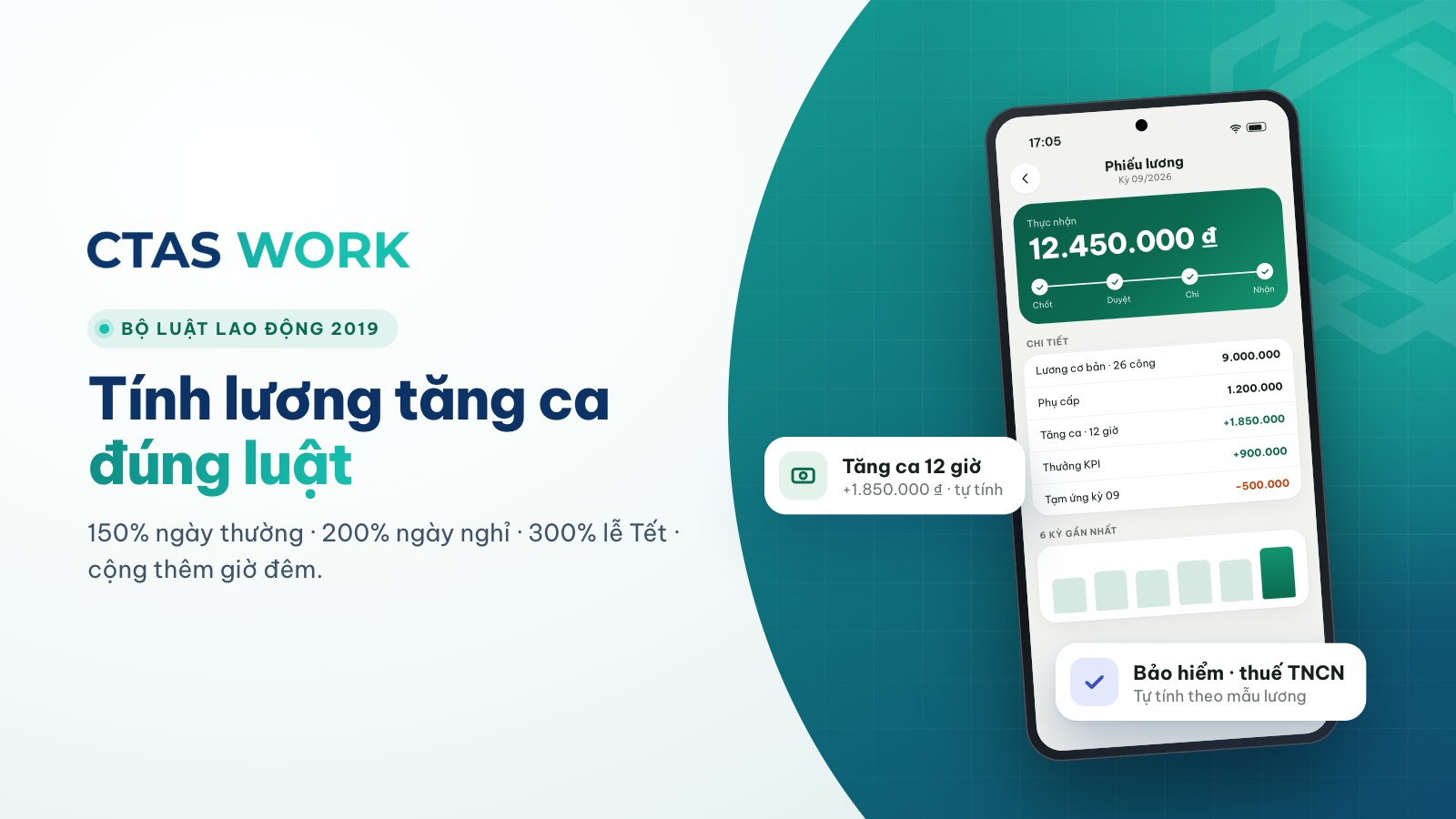
Last month a noodle-shop owner in Binh Thanh asked us: “Our cook worked 3 extra hours on Sunday evening — is paying double right?” The short answer: almost, but it depends on whether Sunday is that cook’s weekly day off, and whether those hours ran past 10 p.m. This article walks through overtime pay under Vietnam’s 2019 Labour Code, with a worked example.
First: what counts as overtime?
Normal working hours are no more than 8 hours a day and 48 hours a week (Article 105). Overtime is any time worked outside the normal hours agreed in the contract or workplace rules (Article 107). If a contract says 6-hour shifts, hours 7 and 8 are already overtime.
Minimum overtime rates
Article 98 sets overtime pay at no less than:
- 150% on normal working days;
- 200% on weekly days off;
- 300% on public holidays and paid leave days — on top of the holiday pay itself for daily-paid staff.
Night work and night overtime
Night hours run from 10 p.m. to 6 a.m. (Article 106):
- Night work earns at least 30% extra of the normal day rate.
- Overtime at night adds a further 20% of the applicable day rate on top of both.
A worked example
Nam, a barista on 30,000 VND/hour, normal shift 2–10 p.m.:
- Wednesday, 2 extra hours (10 p.m.–midnight): 45,000 (150%) + 9,000 (night 30%) + 6,000 (night overtime 20%) = 60,000 × 2 = 120,000 VND.
- Sunday, his weekly day off, 10 a.m.–2 p.m.: 30,000 × 200% × 4 = 240,000 VND.
Overtime limits
Overtime needs the employee’s consent and is capped (Article 107): no more than 50% of normal daily hours, 40 hours a month and 200 hours a year (300 in some sectors).
Common spreadsheet mistakes
- Not splitting out night hours.
- Assuming the shop’s Sunday is everyone’s day off.
- Copying last year’s holiday calendar.
- Overtime agreed verbally with no record.
Let the software split the hours
In CTAS Work you switch each overtime band on or off — weekday, day off, holiday, night — and set your own rates. Hours come from phone clock-ins, so each payslip already separates normal, overtime and night hours. Download CTAS Work and run it alongside your spreadsheet for a month.
For reference only, based on the 2019 Labour Code. Check the latest guidance for special cases.
Related articles
How to calculate annual leave: 12 days, part-year staff and seniority
Days per year, new starters, one extra day every 5 years, unused leave when someone leaves — plus three common shop situations.
4 min read
Can you dock pay for lateness? Paying for time worked vs. fining
The law bans fines and pay cuts as discipline. Is “15 minutes late, 50,000 VND off” wrong? How to handle lateness legally.
4 min read
Payroll form 02-LĐTL: the columns and how to fill them in
What form 02-LĐTL is, its income, deduction, net pay and signature columns, and five mistakes that get payrolls sent back.
3 min read